
Toor, moong, masoor, chana, urad or rajma. Pick the pack for the pot, not the other way around.
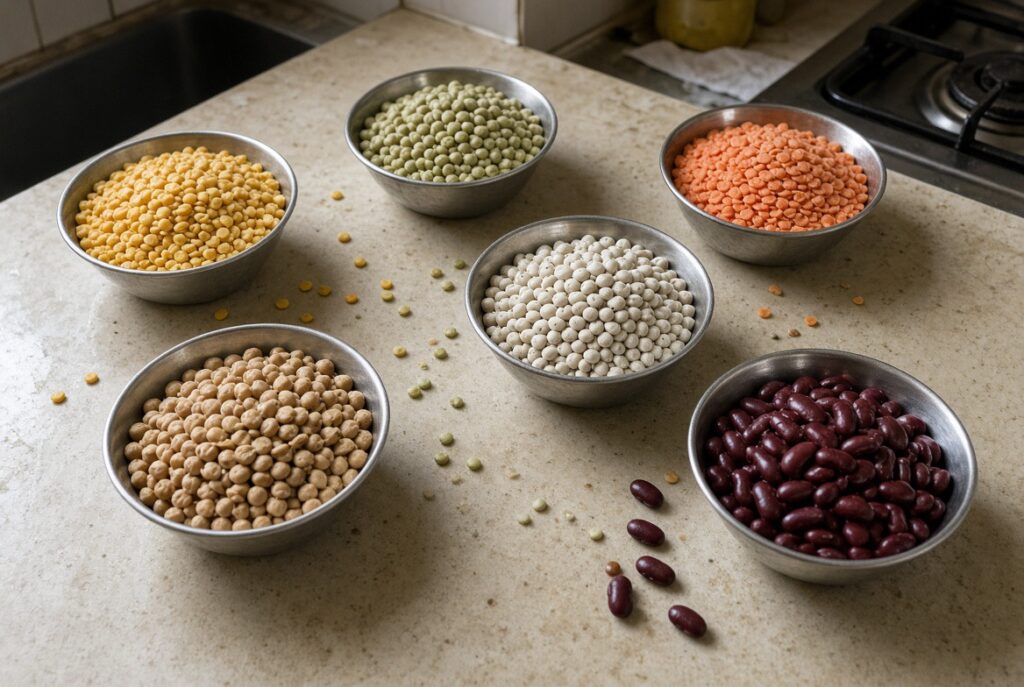
Most “which dal is healthiest” articles skip the only question that matters on a weeknight: which dal belongs in this dish. The wrong pack is why sambar stays thin, dosa batter will not ferment, and rajma stays chalky after two whistles.
This is a buyer’s map for the dals we pack at Puresto. All of them are plain grain, no color, no blending. The difference is shape, skin and soak time.
If you only remember five lines
- Toor — everyday dal, sambar, Gujarati dal.
- Yellow moong — khichdi, light dal, sick-day pot.
- Masoor — fastest dal, soups, weeknight tadka.
- Chana dal — thick dal, vada, sweets, body in a mixed dal.
- Urad split — dal makhani base and South Indian dal. Urad gota — idli and dosa batter.
The one-page match
| Dish | Use this | Soak | Cook |
| Dal tadka, sambar | Toor (arhar) | 20–30 min optional | 3–4 whistles |
| Khichdi, light dal | Yellow moong | Rinse only, or 15 min | 1–2 whistles |
| Quick dal, lentil soup | Masoor split | Rinse | 1–2 whistles or 20 min open pot |
| Chana dal fry, vada, laddoo | Chana dal | 30–60 min | 4–5 whistles |
| Idli, dosa | Urad whole white (gota) | 4–6 hours with rice | Grind, ferment |
| Dal makhani style, kali dal | Urad split plus rajma | Urad 30 min; rajma overnight | Slow, or 6–8 whistles |
| Chole, hummus | Kabuli chana | Overnight | Until a bean crushes |
| Rajma chawal | Red kidney beans | Overnight | Until soft through |
Toor dal: the everyday pot
Toor dal, also called arhar, is the default in most North and West Indian homes. It cooks to a soft, slightly creamy mash and takes a temper of cumin, garlic and dried chilli without disappearing. Use it for plain dal tadka, Gujarati sweet-sour dal, and as the base of sambar with a little chana dal if you want more body.
Rinse until the water is pale. A 20-minute soak is optional. Three to four whistles with turmeric and salt is enough. Do not soak it overnight in a warm UAE kitchen. It starts to smell.
Yellow moong: the light one
Split yellow moong is the weeknight dal and the khichdi dal. It is mild, digests easily, and does not need a long soak. One whistle with rice makes khichdi. Two whistles makes a thin dal you can finish with a small tadka in cold-pressed groundnut oil.
If the pot is for someone unwell, or for a hot Dubai afternoon when you do not want a heavy gravy, this is the pack. Pair it with extra-long basmati and you have a full plate in under 40 minutes.
Masoor: the fast one
Split masoor is the red lentil that turns golden as it cooks. It breaks down quickly, so it is the right dal for a 20-minute pot and for lentil soup. It is also the closest everyday match if you are making an Emirate-style lentil soup and want a softer grain than whole brown lentils.
Do not use masoor when you want distinct grains in the spoon. It will not stay whole. That is a feature for soup, a fault for a dry dal fry.
Chana dal: the one with body
Chana dal is split chickpea. It holds its shape longer than toor and gives a nutty taste. Use it when the dal should have chew: a simple chana dal fry, a mixed dal, or soaked and ground for vada. A handful in sambar stops the pot going watery.
It also grinds into besan at the mill. If you only need a coating or a laddoo, buy the flour. If you need the grain, buy the dal. They are not substitutes in a tadka pot.
Urad: two packs, two jobs
This is the mix-up that causes the most wrong orders.
Urad dal split white is the deskinned split lentil. Use it in everyday dal, in a Punjabi-style black dal with kidney beans, and in some dosa batters if that is your family method.
Urad whole white (gota) is the whole deskinned bean. This is the one for idli and dosa batter with rice. The whole grain ferments better and gives the batter its lift. Buying split urad for idli is why the batter stays flat.
Whole urad with skin (black urad) is a third thing, used in kali dal. If the pack says split white or gota, it is deskinned. Read the name before you add to cart.
Kabul chana and rajma: soak or do not bother
These are not dals in the split-lentil sense. They are whole beans. A 30-minute soak will not save them.
Kabul chana for chole needs an overnight soak, then pressure cooking until a bean mashes with no chalky center. Large 14 mm chana holds shape in a gravy. Do not rush it.
Red kidney beans (rajma) are the same rule. Soak overnight, discard the soak water, and cook until soft. Rajma that is only “mostly soft” will still feel raw. If you are cooking after work, soak in the morning and leave the bowl in the fridge, not on a Sharjah counter at noon.
What to keep in a UAE pantry
Three packs cover almost every week: toor, yellow moong, and either masoor or chana dal. Add urad gota only if you make idli or dosa. Add rajma or kabuli chana when you plan the soak the day before.
Store all of them in a dry jar after opening. An open bag in a humid kitchen is how weevils start, and how a dal picks up the smell of the spice next to it. Cook soaked dal the same day. Do not leave it out.
A useful order is one dal, basmati, and a liter of groundnut oil. That clears the AED 100 free-shipping line and cooks for the week.
Questions we get asked
Which dal is best for everyday dal tadka?
Toor. Yellow moong if you want it lighter and faster.
Which dal cooks fastest?
Split masoor and split yellow moong. Rinse, then one or two whistles.
What is the difference between urad split and urad gota?
Split white is for dal. Whole white gota is for idli and dosa batter. They are not the same pack.
Do I need to soak rajma and chana?
Yes. Overnight, or at least eight hours. Pressure-cook until a bean crushes with no hard core.
Can I mix dals?
Yes. Toor with a little chana dal is the usual sambar mix. A five-dals pot is fine if you soak the slower ones longer. For a full mixed pot, see our Navratan dal.
Stock the dal you will actually cook. Plain 1 kg packs, no additives, free shipping over AED 100.
Shop dals and staples · Order on WhatsApp
Related on the blog: best lentils for protein, moong dal khichdi, and how to cook basmati.